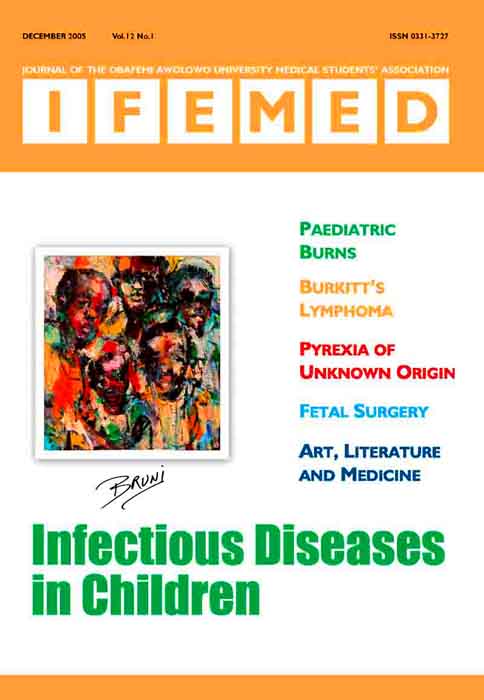
Journal of the Obafemi Awolowo University Medical Students Association
Journal of the Obafemi Awolowo University Medical Students Association
Nigeria, Africa
Seye Abimbola
Editor-in-Chief
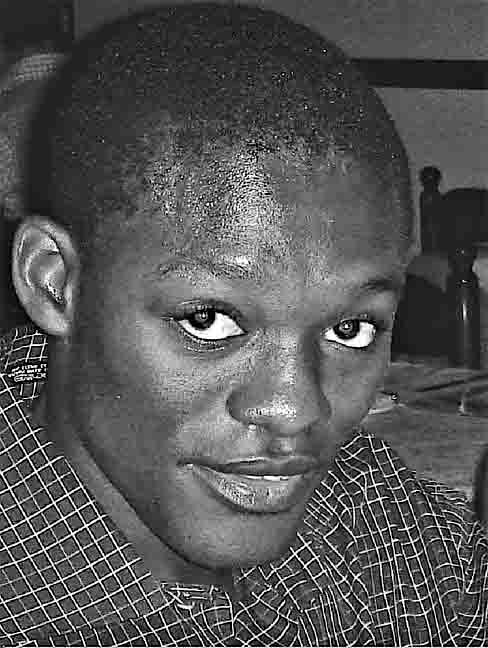
About Seye:
He is 25 years old, and
is a final
year medical student at the
Obafemi Awolowo University, lle-lfe., in Nigeria, Africa.
In addition to his medical studies, he is also an accomplished writer.
ART, LITERATURE AND MEDICINE:
HOW LITERATURE AND ART CAN AFFECT US AS MEDICAL DOCTORS
SEYE ABIMBOLA
"Every artist writes his own autobiography" – Henry Havelock Ellis
I once heard of a girl. Twenty three years old. Tanzanian. It was over the BBC’s breakfast programme, Network Africa. She sent in a letter to the Talk Back segment of the show, and her letter was aired on the twenty first of November, 2003. Although it was not her very voice I was hearing, the dry and yet natural emotion laden tone and well modulated voice that read the letter did well enough to convey the real intensity of her simple and touching message. The letter was centred on the three things she would like to do before she dies.
"There are three things I’d like to do before I die," she started. "Number one, direct a film that wold put my country and me on the map. A film that would gain local and international recognition…"
The second thing she would like to do is to travel around the world and visit all the major cities. But she was afraid time would not permit her. "Number three," she continued, "to affect a person or a group of people’s lives, especially a child, in a positive way. Tanzania being a developing country and all, a majority of it’s people still live below poverty line. I’m among the middle class fortunate ones who don’t have to think of the next meal. I would like very much to be able to pull at least two people to where I am, give them a chance and show them the opportunities.
Then she proceeded to explain why she was having all these longings, hopes, visions and aspirations. "Death is constantly on my mind. I know you must be wondering why. Well, it’s because I’m HIV positive and there isn’t so much hope there. Because having access to medication means you have to be open about your status, which in turn means having to deal with all the scorn and stigma that comes along with that from friends, family, strangers and enemies. I feel that would accelerate my death. So I keep it to myself plus a few people with whom I can trust my life. My immediate goal is to live. I see many people are not living. Even those who are not going through what I am. To them, life is all about dealing with the never ending problems of this world."
And it was in the closing sentences of her letter that I finally go the root, the core of her message. My immediate goal is to live. I see many people are not living. Even those who are not going through what I am … What a deeply piercing thought and observation! Her sight was well illuminated enough to see that our world, the family of mankind, those of us living here and now are divided into the two continuous states of living and dying. She went ahead to identify that she belongs or that she is supposed to belong to the family of the dying. But not stopping there, she took a leap, a giant stride forward to write that those whom she expects to be living are not, and so in other words are dying. And in an instant it became glaringly obvious that herself, and her likes are actually the ones living; those who are indeed, supposed to be the ones dying. It hit me in a hard but subtle way that begun within me, a process of introspective self interrogation. I ended up feeling there was a need to reconstruct her earlier two categories, into one, the living dying and two, the dying living. And then further as three, the living living ( a category I would rather have all humans belong) and the last most pathetic, yet readily excusable, the dying dying.
BETWEEN DEATH AND LITERATURE, A COMMON CREED
Death, as William Shakespeare once said through the mouth of Julius Ceasar, will come when it will come. And this is what the doctor is called upon to avert, to fight. Our chief role is not to eradicate the phenomenon of death, but to prevent it’s misordering. Ensuring that no one dies at too early an age and the old die as peacefully as possible; a battle in which we oftentimes fail.
It is a general truth that we are all dying; the difference between individuals is the length and quality of time that remains. But the deeper truth is that death, the consciousness of the dynamic phenomenon of death renders a person more sensitive to life, the same way darkness increases one’s perception of light and bondage the appreciation of freedom. This is what makes the difference. Between our Tanzanian girl and the people she describes as not living, between the physician-dying patient and any other class of humans but a few.
Few people experience death in its many varied forms and at such relatively frequent instances as we do. Not only do we experience process of dying, we also manage the persistently moribund and tend the dying, some time having to keep the dying patients aware of the imminent potentiality of death when it exists and encouraging them to be positive about it so that they can be able to savour all the beauty and the ugliness of their fast rounding off world; so that they can live it, love it, understand it, and experience it even before the final knell sounds and the bell tolls and the door of time is snapped shut. Doctors are also sometimes left with the task of comforting the deads’ kindred.These daunting roles offer our minds-particularly those of us that open up our minds to the numinous effect of such experiences-the-opportunity of gaining a wide range through the subjective flex of new and turbulent emotions. This is exactly the same thing that happens to the minds from which deep works of literature are wrung out and fashioned. Such minds as have been made of force to suffer and who have had to experience or witness human suffering and weakness with a profound sense of empathy. The likes of Fyodor Dostoevsky’s The Brothers Karamazov, Alexander Solzhenitsyn’s Cancer Ward, Albert Camus’ The Plague, Nelson Mandela’s Long Walk to Freedom, Nadine Gordimer’s July People, Harper Lee’s To Kill a Mocking Bird, and a whole host of other writers and books from a very wide pool of possible examples, bring to us a wide range of human experiences that expand our humanity and at the same time add to the depth of our budding personalities as medial students. There is a way in which they surreptitiously modify our behaviour and alter our general outlook to life.
The almost ascetic lifestyle many of the men given to the arts adopt is a testimony to the profoundness of mind necessary for creating and appreciating truly sublime works of art.
HOW CAN ART AND LITERATURE AFFECT US?
I was forced to ask: What could have prompted the girl from Tanzania to pick up her pen and paper to write, or to fan out her fingers to type the mail and send it down to the BBC? I was left with no option but to consider it an aspect of fulfilling her yearning for self-expression, a feeling every single writer, nay artist, shares. I believe that in reaching and touching me like many authors have done, she is indeed truly fulfilled. Telling her own story, not minding the scanty details must have been her own way of biting off a large chunk from the fleeting bread of life.
Literature is a reciprocal stream of benefits. We stand to gain a great lot from the influence that comes by listening to or reading the stories of others. Dannie Abse, a poet-physician, who is also an earnest believer in the importance of poetry to the medical doctor and student once said that: "…by reading poems and stories about people afflicted mentally or lowered by physical illness, the medical student, on occasion is better able to respond to patients. The best healers are…those who are sensitive but tough and who can, to a degree, empathize with their patient’s predicament. The patient’s point of view, ventilated through an anecdote poem or a portrait poem, or through a prose narrative, can lead students to be more aware of parallel real-life situations such as they may encounter in the future.
We live in an estranged world and it is only through the communication of souls, the subjective transfer of lived experiences that we can make the wisdom of the other truly ours. From time immemorial, man has been made in such a way that his vision of the world, his motivations and scale of values, his actions and intentions are determined by his personal experience of life. Although, as it is widely believed, experience is the best teacher and in fact, I agree that is the soundest basis for understanding the world around us and of human conduct in it. But how many experiences do we hope to submit ourselves to before we begin to appreciate the many facets and hues of life and the many examples of those who have lived both creditably well and unwell in them, both in reality and fiction?
The only substitute for an experience we ourselves have never lived though is art, literature. Art can perform the miracle. Literature does overcome man’s detrimental peculiarity of learning only from personal experience. It recreates in the flesh a hitherto unknown experience and allows us to possess it as our own. It has the wonderful ability of conveying the life experiences and the depths of imagination of one person to another. Indeed, the stories that are shared modify the physician’s personal responses to events, to situations, and the interpersonal connections provide an opportunity for us to reflect on our and their lives.
The many doctors that have been writers, the many physicians that have hung the stethoscope to tell stories and surgeons that have dropped the scalpel to convey far reaching experiences have much to teach us both in their narration’s and the questions they raise. W. Somerset Maugham, William Carlos Williams, Robin Cook, John Keats, Anton Chekov, Richard Selzer, John Stone, Dannie Abse and our own Wale Okediran are ready examples of doctors, some of who have left us and some other who still keep on providing us with stories and insights that will continue to inform and baffle us alike.
Robin Cook is an adept at raising questions bordering around
biomedical ethics in his many novels, particularly in his magnum opus, Coma,
where he addressed with foresight, the timely issue of organ transplantation and
banking. The ethical question raised by William Carlos William’s increasingly
popular short story, "The Use of Force", is an example that is usually cited.
The story is about a very young girl whose fever a physician suspected stemmed
from diphtheria. Probably for the fear of pain, the girl stubbornly clenched her
jaws, resisting all attempts to have her throat examined. The girl’s parents and
the physician tried all they could to bring her to submission but she would not
yield. After spending much time, the physician, desperate and deeply frustrated,
eventually launched what the author called a final unreasoning assault.
Just a paragraph:
Every one of us needs an outlet, a safety valve, a hobby, a coping mechanism that allows for escape. In their journalistic tour de force on brain surgeons and their patients, Not Quite a Miracle, Jon Franklin and Alan Doelp wrote about neurosurgeons that employed scuba diving, gardening, alcohol, ego, and baseball as coping mechanisms. But when it was time to talk about Dr. Michael Salchman, then deputy chief of Neurosurgery at University of Maryland Hospital, they said:
"Michael had firm opinions about the opera, for instance. He wrote poetry, and he and his wife Ilene spent considerable time poking through modern art galleries. He talked about such things with great enthusiasm…it was a different kind of joy…One could tell that he…took something important from his art collection, something indefinable, something…"
They went ahead to say that Michael’s Art collection had one huge advantage over his colleagues’ sailboat or garden for example. In winter, the scuba diver had to content himself with squash and the gardener had to fall back on seed catalogues. But Michael cold collect his art, and enjoy it all year long.
I’ve even once read of a surgeon who placed a favourite artwork opposite his staircase so that whenever he was going out for an operation, particularly the delicate ones, he would wait a minute or two to stare at the painting and by so doing, achieve a calming effect.
A PERSONAL PERSPECTIVE
Although I would readily concede to the fact that I know very little, having witnessed but a few in the process of my maturation into a doctor. I am like Newton’s toddler at the seashore toying with the fine sands, yet to be initiated into the vagaries of life. And this is in it self an advantage, for familiarity breeds contempt, insensitivity and blind acceptance devoid of the fascination, thrill and even the amusement that comes along with appreciation occasioned by novel encounters and fresh, sober ruminations.
If the child were already sailing across the sea, little will he see. The enormity of its expanse would have totally escaped his sight and imagination. But a t the seashore, he appreciates how little he knows, and he recognizes, all at once what uncharted water lay before him to throw himself at and navigate.
Sometimes I fear and sometimes my fears are allayed. I fear that I’ve even probably started failing on this journey I’ve barely begun. The more I come in contact with patients and all other people seeking help in any particular way, the more I am inclined to erect a psychological barrier between myself and them. And this tendency starts right here. With what we do as clinical students and what will eventually become the mainstay of our practice as doctors. With taking history, performing physical examinations and having them recorded in prose. Reading these stories, these poems certainly get us more acquainted with our patients’ ailments, with people’s predicaments, with the lives of our fellow humans. It would awaken you to the peculiar life stories of your patients and the ones that would come in the future and you wold doubtless become wiser with further knowledge and life experiences. And from this will open a wellspring of proper, painstaking familiarity. The unusual ability to take a knowing look at ourselves and our patients.
CONCLUSION
One thing I know for sure is that all of us need to have an extensive span of experience in order that our lives be lived aright, particularly as we discharge our professional duties. To read the stories of our lives and of the lives of those that have crossed ours, especially our patients, through the many works of serious literature we would come across and pick up to read. To ponder on a piece of art work and by so doing be uplifted. To interpret them with a personal perspective, to give a personal reading of the impression being conveyed, of their message like I did with the Tanzanian girl’s story. This is a veritable way of harnessing the force of death and the products of imagination and human suffering to our favour, reading and appreciating these works and partaking in these experiences is what I call on us medical students and doctors to emulate. We would all certainly be the better for it.
REFERENCES:
Dictionary of Quotations. Geddes & Grosset, New Lanark. 1994: 139
Longmore M, Wilkinson T, Torok E. Oxford Handbook of Clinical Medicine. 5th edition. Oxford University Press, Oxford. 2001: 6
Mack RM. Lessons from living with cancer. N. Engl. J. Med. 1984; 311: 1640.
Gordimer N. Writing and Being. Nobel e-Museum, The Nobel Foundation.
Abse D. Literature and Medicine; More than a Green Placebo. The Lancet. 1998; 351:326-364.
Solzhenitsyn Al. Nobel Lectures. Nobel e-Museum, The Nobel Foundation.
Williams WC. The Use of Force. In Williams WC. The Doctor Stories. Compiled by Coles R. New Directions, New York, 1984: 59
Franklin J, Doelp A. Not Quite A Miracle: Brain Surgeons and their Patients on the Frontiers of Medicine. Doubleday & Company, New York, 1983: 133-134.
MIDNIGHT CALL
by Seye Abimbola
My room seemed to me the Goshen of the ninth Egyptian
plague as I peeped through the window in an attempt to hear the shouts and wails
more clearly. No street lights, no corridor lights, no passageway lights. All
was dark outside. The Nigeria of my own youth was not the Nigeria of my father’s
youth. Structures and infrastructures were now dilapidated, destroyed or being
looted in bits. It seemed all was gone. And all were truly going, slipping off
our holds by little almost unrecognizable installments. So unsudden was it that
our adaptations to the realities as they came were likewise imperceptible.
Swift. With each tiny step down the minute rungs of the ladder of progress.
I looked out and saw nobody. The darkness was thick, palpable. Not even a single
firefly was on the grasses or in the air to give some tiny trails of lemon
light. Nature itself, it seemed, was at war with us. I released the window blind
and slipped back on my bed, took a sad look at the books that had come to
dominate my life, and sued for further sleep. But it couldn’t have been
different for us. A generation born at the height of corruption and greed in
high places, of pilfering and looting in low places, at the height of
governmental insensitivity couldn’t have lived otherwise. We grew into it. It
became our culture, our second nature. We needed not imbibe it. It was already
well woven into the fabrics of our minds. An all pervading tradition of
indiscipline. We stood as the conspicuous, yet ignored vestiges of our parents’
misbehaviours. They had fully bred an incorrigible generation.
The screams kept coming. It was a delicate, almost feminine voice. With the shouts for help growing louder and louder, the cries getting more and more strident, I could not resist the urge to stand up, open the door and step out. And so I did. Not even the darkness could hold me back from launching out in search of the room the noise was coming from. It was not at all hard locating. The only lighted, dimly though, two blocks away from mine. I knocked the unlocked door open and I saw her as she hurriedly went to sit at the other end of the bed facing the wall and window, shivering, sobbing quietly. I looked down and I saw him on the floor lying lifeless, motionless, sweaty, naked. "Hello sister".
"Yes brother. He’s dead. He’s gone. You can see he’s dead and gone. My brother, my lover, my friend. He's gone, and I'm responsible. I never told him to go to the hospital. He was always complaining of chest pain, and he even did on our way here yesternight. Or could it be that spell, that spell called Magun. I know I killed him. I know. I did. I know I’m responsible. She said amidst sobs.
"It couldn’t have been Magun", I said to myself as I knelt down beside him. I reached straightaway for his cold wrist, for his radial artery, and smiled to myself when I discovered it was still there, albeit weak and irregular and for the first time I saw that I knew the guy quite well. We had exchanged greetings once or twice along one of the footpaths on campus.
"Put on the light please, I mean the florescent tube", I ordered, and she responded immediately. The light came so bright. I took a look at his pupils and found they were only half dilated. I sighed. Fair sign. "He doesn’t appear to have passed away. At least not yet, although he’s sure right on his way. We can still do something." I looked at her, finding it hard to give her my pity.
She wiped her face with her palm, still shivering, backed me and tied her
wrapper more tightly. I guess that was probably all she had on. She moved closer
and stood still, head hanged, looking down at us as I removed the pillow from
the bed and slipped it under his neck and shoulder. I wasn’t too sure I was
doing the right thing, but it was better to do the wrong thing than nothing at
all. I peered down his throat and the next thing was to do a mouth-to-mouth. I
wasn’t too ready. He must have kissed this girl, I thought to myself.
Cunnilingus? Kissing after fellatio? I closed my eyes. I couldn’t bear the
thoughts. Such dreary thoughts as oral thrush, candidiasis, syphilis…I braved up
in a moment, and looked up at her and…and she’s not so bad after all, lips
enticing enough, good curves all around the place. I shrugged. Mouth-to-mouth
began in a moment, pinched his nose, filled his lungs twice and then felt for
the carotid pulse. Not there. Filled the lungs for another two rounds and then
another two and the carotid started coming. He started breathing by himself.
"Sister, call him, call him by his name". "Yes sir", she answered me.
"Ben…Benson…Benson…Bennie", she called. No answer.
I leant my back backwards, straightened my spine and forelimbs and headed
straight for the lower half of his sternum, pressing the whole weight of my
torso against his chest. Twelve times I pressed, twelve times at the rate of
once per second as the books had said and the miracle happened. I peered into
his eyes once again and I saw that his pupils were now constricted, almost to
their normal sizes.
"Benson", I called again. "Are you back, Benson are you?" "Yes", he answered
feebly. It was a very feeble yes, "Floxie, where is Floxie". He asked softly,
almost inaudibly. Then both eyelids approached each other again.
"Dress up quickly my dear", I said as I looked up at her. "He’s coming back, gradually, in fact he’s almost back. We have to rush him down to the University Health Centre for proper attention. The place is very close by. Just some two minutes walk from here. I’m only a fourth year medical student and only little can be done for him here. Do you get? And prepare to dress him up too. At least a pair of trousers".
She paced quickly to the wardrobe, removed her clothes from the hanger and
hid herself with the door or the wardrobe. The next moment I saw her, she was
fully dressed. Shivering subsided. More calm. She picked his trousers from the
other bed, approached, bent down at his feet, and slipped the legs in gently.
She was done in a jiffy. Then she stood up. I was already standing, looking
around, wondering how many such deaths must have been credited to the spell
magun. I was hungry for the story. Sure it would make a minuscule action
packed movie. Iwas almost blaming myself for having not asked her earlier, when
the hope of his survival was a lot bleaker. "I am set", she said more
confidently, although slightly genuflecting. "OK, do you have a lamp in here?
"Yes, there is a torch". "Then grab it and lets go".
She scrambled around for it, found it, and we were set to go. He was a guy of
slight build. Not so difficult to lift. I grabbed his trunk with my left hand
and suspended his head with my right. She lifted him by the legs with her left
hand, held the torchlight in her other hand, evidently an energetic girl of
moderate build.
We arrived at the Health Centre in less than two minutes. Two elderly nurses
were sleeping in the nurses station. No orderly. We headed for the out patients’
consulting room where we met the young doctor. He was reading the ninth edition
of Last’s anatomy, apparently an MO preparing for his fellowship primaries.
"Good morning doc", I greeted. "Yeay, what can I do for you?" He answered with
an air smiling with the far edge of his mouth. "Syncope during intercourse, did
a CPR for him, the ABC. And he responded positively. We are here for further
management". I responded somewhat proudly, trying to make him realize I’m a
colleague.
He stood up, and ordered us to follow him, not betraying the slightest knowledge of my status. We got into the ward, and he ordered us to lay him on the bed, and then ordered the girl out.
"Is he a student?" He asked as he proceeded to set up an IV line. "Yes, or well I suppose he is, I see him around". "What is your impression of the patient? I mean the aetiology of the attack."
"An MI maybe, or VF secondary to an MI following increased myocardial
activity and decreased myocardial perfusion. The girl, I mean her girlfriend,
the one outside told me he had always complained of chest pain". He nodded as I
answered, puffing out his lips to give the impression that I had not impressed
him. "Very well. What should we do? You are a medical student, aren’t you?"
"Yes, I nodded."
"What year"
"Four"
"Clinical one. OK don’t worry your self about that". We need a defibrillator and we don’t have any here. The ambulance drivers are not around and I didn’t bring my car. We may have to wait for three hours at least to get a car. You know, the break. Everywhere is quiet. No cars around. And we need to get to the teaching hospital. And I’m not even sure there’s a functioning defibrillator there. You leave the ward now and join her outside. I would try all that can be done. But chances are slim".
I left the ward. She was standing at the door. And I saw it on her face. She
heard all that the doctor told me. I took her by the hand. And led her through
the corridor to the waiting bench. "So he would still die". "He may not. Let’s
just wait. We may be lucky after all. But…er…er…how did it happen." She started
weeping. Weeping profusely.
"We’ve been going out for about four years now. And this is our first time
together. His own very first time. The chest pain had been coming and going
since. Since about two years now. When it comes, he would rest and then it would
go, just like that. And I didn’t know it was this terrible. I pray he doesn’t
die. I pray. Well I thought he dad died already but maybe God would grant him a
second chance." She said, avoiding the details.
She started sobbing all over again, now with now break, continuously. I stared to pet her, patting her back, wiping her tears with my palm and drying it off my trousers. I tried to reassure her, but I couldn’t stop the flow. She wept througout the thirty minutes that elapsed before the doctor arrived.
"He finally gave up", the doctor said.
Immediately, she swung herself on the floor and started wailing. I stood up from the bench, looked at the doctor and started weeping. The tears came in dribbles. I couldn’t say for whom it was. I had been thinking about Nigeria, the whole health care delivery system was decaying. Every single sector was. And Nigeria, oh Nigeria no matter how much we tried to resuscitate her, she would still slip into coma, death. With out several shots at democracy eventually turning sour. We would try and try and try as we may, it would slip again. As if the country was doomed never to survive. Some diabolical forces would come from nowhere and scatter all that we’d spent years gathering. We couldn’t pull the various units together, we couldn’t find a centre, not even the Abuja abstraction could afford us one. We were always almost there, and it would disintegrate, disappear. Always almost but never, like a motor vehicle approaching a tarmac mirage. It seemed Nigeria was doomed never to make it to nationhood.
She was very energetic. I stood there transfixed for fifteen minutes. Thinking about the many ways we had failed as a nation. Thinking about how all the efforts had gone down the drain, wasted. My efforts on Benson.
The nurses were now awake. The day was breaking. The doctor lifted her from the ground and led her into the consulting room. I was still standing. And slowly, heavily, I walked away, remembering the fate of King Sisyphus of classical mythology.
Please feel free to email BRUNI for further details: bruni@brunijazzart.com
BRUNI Gallery
394 E. Campbell Ave
Campbell, CA 95008
(408) 370-4700
Fax (408) 871-7903
www.brunijazzart.com
bruni@brunijazzart.com